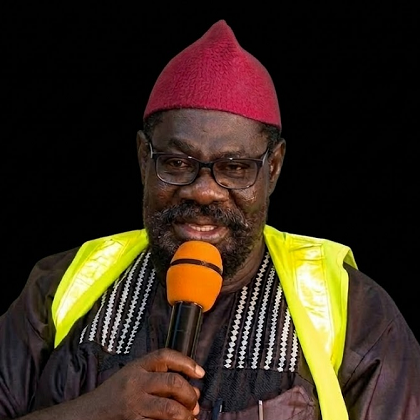
Sheikh Adam Abdullah Akachukwu Idoko was a Nigerian Islamic scholar, teacher, and Vice President II of the Supreme Council for Shariah in Nigeria, known for advancing Islamic education, da’wah, and peaceful coexistence, particularly in Southeastern Nigeria.

Biography
Sheikh Adam Abdullah Akachukwu Idoko was a distinguished Islamic scholar, teacher, administrator, and community leader whose life was devoted to the propagation of Islam, the promotion of peaceful coexistence, and the advancement of the Nigerian Muslim Ummah, particularly in the Southeastern region of Nigeria. He serves as the Vice President II of the Supreme Council for Shariah in Nigeria (SCSN), where he contributes to the Council’s mission of advancing Islamic scholarship, strengthening Muslim institutions, and promoting the constitutional rights and welfare of Muslims across Nigeria.
Born in Umuogbo Ekposi, Enugu-Ezike in Igbo Eze North Local Government Area of Enugu State, Sheikh Idoko grew up in an environment that nurtured strong moral discipline and a deep commitment to Islamic learning. His early educational journey began with the study of the Qur’an and foundational Islamic sciences under traditional scholars. Demonstrating exceptional dedication and intellectual curiosity from a young age, he devoted himself to the study of Arabic, Qur’anic exegesis, Hadith, and Islamic jurisprudence.
His eagerness to deepen his knowledge of Islam later took him to the Islamic University of Madinah in the Kingdom of Saudi Arabia, where he studied Shariah and graduated with a Bachelor’s degree in 1984. Equipped with sound scholarship and a strong grounding in Islamic jurisprudence, Sheikh Idoko returned to Nigeria and soon established himself among the respected community of Islamic scholars and da’wah activists in the country.
Throughout his life, Sheikh Idoko demonstrated remarkable consistency of purpose in the field of Da’wah (calling people to the path of Islam). His contemporary and inclusive approach to Islamic propagation contributed significantly to the growth and development of Islam in Southeastern Nigeria, a region where Muslims are often a minority and where indigenous Muslim communities have historically faced numerous social and religious challenges. Through wisdom, patience, and exemplary conduct, he consistently promoted dialogue, understanding, and peaceful coexistence among people of different faiths and ethnic backgrounds.
His scholarship and dedication earned him recognition from government and public institutions. In 1988, he was appointed Secretary of the Anambra State Muslim Pilgrims Welfare Board, a position he held until 1992. Following the creation of Enugu State in 1991, he became the Pioneer Chairman of the Enugu State Muslim Pilgrims Welfare Board (1992–1995). His administrative competence and deep knowledge of Islamic affairs later led to his appointment as a Part-Time Commissioner representing the Southeastern region on the Board of the National Hajj Commission of Nigeria (NAHCON).
Beyond public service, Sheikh Idoko played a central role in Islamic institutional leadership and community development. He served as the Chief Imam of the University of Nigeria, Nsukka, where he provided spiritual leadership to the university’s Muslim community and the wider society. He also served as Director of the Islamic Education, Peace and Development Centre in Umuogbo Ekposi, Enugu, and as President-General of the League of Islamic Scholars and Missionaries of Eastern Nigeria, positions through which he strengthened Islamic education and coordinated da’wah activities across the region.
His influence extended to national Islamic platforms. Sheikh Idoko was actively involved in major Islamic organizations and initiatives dedicated to strengthening Muslim institutions and protecting the welfare of Muslims in Nigeria. Within the Supreme Council for Shariah in Nigeria (SCSN), he contributed to efforts aimed at advancing Islamic scholarship, promoting justice, and defending the constitutional rights of Muslims while encouraging peaceful coexistence in Nigeria’s pluralistic society.
Known for his humility, generosity, and unwavering commitment to service, Sheikh Idoko was widely respected across Nigeria. His sermons, lectures, and public engagements inspired many and helped nurture a deeper understanding of Islamic teachings, moral responsibility, and community development. His leadership style emphasized moderation, inclusiveness, and cooperation among Muslims of different ethnic and regional backgrounds.
Many who worked closely with him testify to his remarkable dedication and selflessness. His contributions to humanitarian initiatives, including charitable and Zakat distribution programmes across the Southeast, reflected his belief in Islam as a force for compassion and social justice. He often emphasized that the benefits of Islamic charity should extend to the broader society in order to promote goodwill and demonstrate the inclusive spirit of Islam.
Despite operating in an environment where Muslims were often marginalized, Sheikh Idoko remained steadfast in promoting harmony and responding to hostility with patience and goodness, in line with the Qur’anic injunction: “Nor can goodness and evil be equal. Repel evil with what is better; then the one between whom and you was hatred will become as though he were a close friend.” (Qur’an 41:34).
With his commanding presence, intellectual depth, and humane disposition, Sheikh Idoko earned admiration from scholars, community leaders, and ordinary citizens alike. He was widely regarded as a selfless servant of the Ummah and a worthy ambassador of Islam, always ready to support Islamic causes and community initiatives at short notice.
Until his demise, Sheikh Adam Abdullah Akachukwu Idoko remained a tireless advocate for Islamic education, inter-community harmony, and the advancement of the Muslim community in Nigeria. His life of scholarship, service, and dedication continues to inspire scholars, students, and activists across the country. Through the institutions he strengthened, the students he mentored, and the communities he served, his legacy remains an enduring contribution to the intellectual and spiritual development of Islam in Nigeria.
Plot #6, West College Road, Off Gwamna Road, Kaduna Nigeria
Mon – Fri: 8:00 am – 6:00 pm
Islamic Resources
Social Media
SCSN News & Updates
The latest news, articles, and resources, sent straight to your inbox every month.