
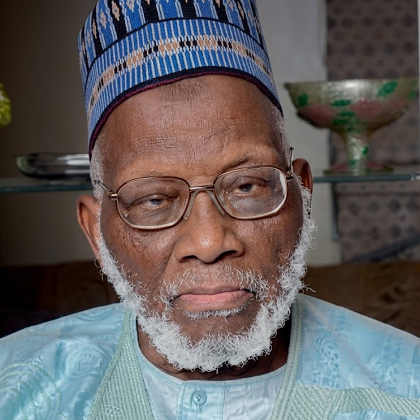
Nigerian Muslim leader and founder of the Supreme Council for Shariah in Nigeria, was a physician, scholar, and advocate for justice, Islamic values, and constitutional rights, leaving a lasting legacy in governance, healthcare, and community leadership.

Biography
Dr. Ibrahim Datti Ahmad was one of Nigeria’s most distinguished Muslim leaders, intellectuals, and professionals who dedicated his life to the advancement of Islamic values, justice, and good governance. He is best remembered as the founding President of the Supreme Council for Shariah in Nigeria (SCSN), an influential umbrella body of Islamic scholars, professionals, and community leaders committed to the promotion and protection of Islamic values in Nigeria. Through his leadership, the Council emerged as one of the most important voices of the Nigerian Muslim Ummah on national issues, particularly in defending the constitutional rights of Muslims to practise and promote the Shariah within the framework of the Nigerian state.
Dr. Datti Ahmad was born in 1936 in Kano, Northern Nigeria, into a respected Muslim family known for its strong religious and community traditions. From an early age, he combined Islamic learning with Western education, a combination that later shaped his intellectual outlook and leadership style. He attended the prestigious Barewa College in Zaria, one of Northern Nigeria’s most influential secondary schools that produced many of the region’s political and intellectual leaders. He later proceeded to the University of Ibadan, where he studied medicine and qualified as a medical doctor. He subsequently specialized in urology and became one of the earliest Western-trained medical doctors from Kano, building a reputation as a skilled practitioner and dedicated humanitarian.
In the course of his medical career, Dr. Datti Ahmad made significant contributions to healthcare delivery, particularly in Northern Nigeria. He established Asmau Memorial Hospital in Kano, which later evolved into a specialized urology centre, and he became widely known for providing medical services to both the privileged and the poor. Beyond his medical work, he remained deeply engaged in intellectual discourse, Islamic scholarship, and community development, gradually emerging as one of the most respected Muslim public figures in Nigeria.
Dr. Datti Ahmad’s most enduring legacy, however, lies in his leadership of the Supreme Council for Shariah in Nigeria. As the pioneer President of the Council, he provided strategic leadership and intellectual direction that shaped the organization into a major platform for Islamic advocacy in Nigeria. Under his guidance, the Council brought together Islamic scholars, professionals, and Muslim leaders to articulate the collective aspirations of the Muslim community and to provide guidance on national issues affecting the Ummah. His leadership emphasized unity among Muslims, peaceful advocacy, and constructive engagement with the Nigerian state.
One of the defining moments of his leadership came during the Shariah re-implementation movement that began in Northern Nigeria in 1999. Through the Council, Dr. Datti Ahmad played a pivotal role in mobilizing scholars, professionals, and community leaders in support of the constitutional application of Shariah in Muslim-majority states. The Council provided intellectual advocacy, public education on the principles and objectives of Islamic law, and strategic engagement with political leaders and policymakers. These efforts contributed significantly to the adoption of Shariah legal systems in several northern states and to the broader national discourse on religious freedom and constitutional rights.
Beyond Islamic advocacy, Dr. Datti Ahmad was widely respected as a national figure who contributed to dialogue on governance, religion, and national stability. He consistently advocated justice, accountability, and moral leadership in public affairs, while promoting peaceful engagement and responsible participation in democratic processes. His influence extended beyond the Muslim community, earning him recognition as a principled leader whose views carried weight among scholars, policymakers, and civil society actors.
Dr. Datti Ahmad also believed strongly that Muslims should actively participate in democratic governance. In the early 1990s, he contested for the presidency under the Social Democratic Party during Nigeria’s Third Republic, reflecting his conviction that ethical leadership and Islamic values should positively influence public administration and national development.
Dr. Ibrahim Datti Ahmad passed away in December 2021 after a lifetime of service to faith, community, and nation. His legacy continues through the enduring work of the Supreme Council for Shariah in Nigeria and through the many scholars, leaders, and professionals he inspired. He is widely remembered as a pioneer of Islamic advocacy in contemporary Nigeria, a courageous defender of the rights and dignity of the Muslim Ummah, and a leader whose life exemplified dedication, integrity, and service to society.
Plot #6, West College Road, Off Gwamna Road, Kaduna Nigeria
Mon – Fri: 8:00 am – 6:00 pm
Islamic Resources
Social Media
SCSN News & Updates
The latest news, articles, and resources, sent straight to your inbox every month.